

"Come Holy Spirit"
Blessed Pentecost Sunday - An Epiklesis Spirit Invocation

Blessed Pentecost Sunday!
In the words of Pope John XXIII, who opened Vatican II on 11 October 1962 with this prayer:
“Come Holy Spirit, give us a second Pentecost!”
There is evidence that this kind of invocation of the Holy Spirit was a practice in the post apostolic church. Dating back to the 4th century, the Greek word Epiklesis was used of the Holy Spirit, meaning literally, to “call down upon” someone or something. The church fathers refer to this practice, as in Cyril of Jerusalem (c. 350 AD), Serapion of Thmuis (c. 360 AD), and Basil the Great (c. 370 AD). It was a prayer invoking the Spirit to fall on someone, or a congregation, or the Eucharist elements (the body and blood of our Lord)… just as the Spirit fell on the early church at Pentecost.
Over the years Christians have debated if it is “scriptural” to pray to the Holy Spirit. Yahweh told Ezekiel (in chapter 37) to call directly upon the Ruach (Spirit, Breath) of God to breathe into Israel, “Come, Ruach, from the four winds and breathe into these slain, that they may live”... there it is!
Church historians trace the above prayer of Pope John XXIII as the source or beginning of the outpouring of God’s Spirit on Catholics, who began to pray in tongues. That marked the start of the Catholic charismatic renewal that crossed over into the Anglicans and all the mainline churches in the 1960s and 70s. It swept the whole worldwide church - known as the Charismatic Renewal - with a fresh empowering of the supernatural gifts of the Spirit, exercised not exclusively by the clergy, but most significantly and extensively by Christians everywhere. The ministry of the Holy Spirit went from the pulpit to the pew and out onto the streets.
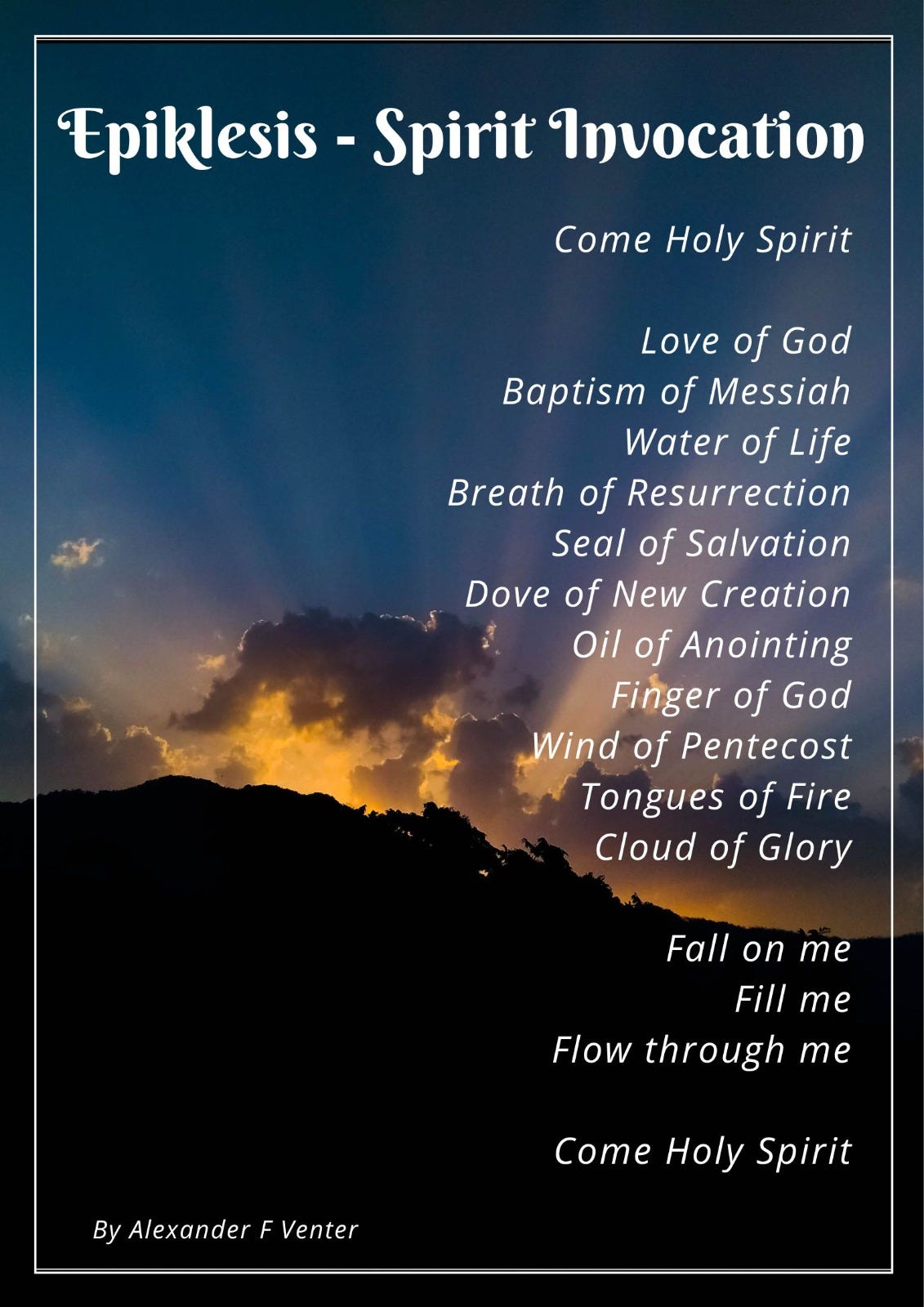
Years ago, in keeping with the Church Fathers, I wrote an “Epiklesis - Spirit Invocation”. I sought to capture all the symbols of the Holy Spirit that scripture uses to describe the work and effect of the Spirit on, in, through all who follow Jesus. My Epiklesis flows logically from one symbol to the next, for easy memorisation and prayer.
I pray this Epiklesis Spirit Invocation phrase by phrase as I go through the day. I pray it with my breath, in and out. It makes me think about each and every phrase as I pray it slowly, rhythmically, with my breathing. It has become one of my (numerous) ‘Breath Prayers’ that I’ve developed and prayed over many years.
The more one prays the Epiklesis, the more it enters one’s heart and spirit, becoming a subjective reality, our lived experience. The Eastern Orthodox, especially the monastic tradition, teaches breath prayers - The Jesus Prayer, for example - as a three step process of months and years of regular daily practice:
The Prayer of the lips - pray it verbally throughout the day, then it becomes…
The Prayer of the mind - praying it in your thoughts with your breath, then it eventually becomes…
The Prayer of the heart - your spirit prays the words, even beyond or below your conscious mind. You begin to pray continually or unceasingly, as Paul instructs, becoming a living breathing prayer to God.
Why not memorise this Epiklesis Spirit Invocation and pray it daily... and see what God does in you, to you, and through you!
Blessed Pentecost Sunday!
Come Holy Spirit!
See less